Mother to an Angel T-Shirt Design
A Quiet Moment, Not a Quick Print
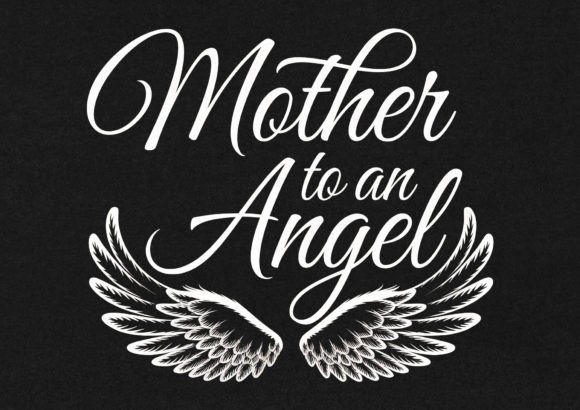
When I first opened the Mother to an Angel T-Shirt Design, I didn’t see a graphic—I saw a pause. A breath held. The composition leans into softness: gentle curves, balanced negative space, and a subtle, centered motif that suggests reverence without ornamentation. It’s not bold or trendy—it’s tender. That matters deeply when you’re translating it into stitch. I immediately pictured it on a lightweight cotton tote for a bereavement support group, stitched in matte ecru thread on oat-colored canvas—not because it’s flashy, but because its quiet dignity holds up under real-world wear and emotional weight.
Where This Design Finds Its Truest Stitch
This isn’t a one-size-fits-all embroidery file. It shines where intention meets texture: on baby onesies (using ultra-soft stabilizer and low-density fill stitch), on linen tea towels for a boutique nursery line, or as a small embroidered patch on a denim jacket lapel. I tested a scaled-down version on a 4-inch hoop for a child’s sweatshirt—no crowding, no distortion. The layout leaves room for breathing, which means fewer tension issues across curved seams or ribbed cuffs. As a tote bag design, it anchors the front panel without overwhelming; as sweatshirt embroidery, it reads clearly even at arm’s length. For personalized gifts, its simplicity invites customization—think adding a single birthstone icon or a delicate date below the main phrase—but only if the original file allows clean vector editing (check your PNG’s scalability before committing).
What You’ll Want to Watch Closely
- Small hoop sizes: The lettering is legible at 3.5", but drops off sharply below 2.75". Avoid using it full-size on caps unless you confirm the design fits comfortably within standard cap hoops—and always test on scrap fabric with the same curve and stretch.
- Textured or dark fabrics: Because this is delivered as a PNG—not a native embroidery file—the stitch density, satin stitch width, and underlay are entirely up to *you*. On terry cloth towels or fleece, dense fill areas may pucker. On charcoal or navy fabric, light thread colors (like ivory or pale gray) can vanish unless you adjust contrast in your embroidery software or choose richer tonal matches.
- Frequent-wash items: If you plan to use Mother to an Angel T-Shirt Design on baby clothes or kitchen linens, reduce fill stitch density by 15–20% and add a light tear-away stabilizer underneath. Over-stitched areas fatigue faster—even beautiful ones.
- Commercial embroidery projects: Since only a PNG and mockup are included—not DST, PES, or EXP files—you’ll need to digitize it yourself or hire a digitizer. Don’t assume auto-digitizing software will honor the nuance in the curve of “Angel” or the spacing between “Mother” and “to.” That subtlety is part of what makes it feel handmade—not machine-perfect.
How It Shapes Perception—Before and After Stitching
Customers don’t buy graphics. They buy feeling, trust, and care—and this design delivers that *if* executed thoughtfully. When stitched cleanly on a well-chosen fabric, it elevates a simple handmade product into something quietly meaningful. I’ve seen similar phrases fall flat on cheap tees with jagged edges or muddy thread blends; here, the clean lines and intentional spacing give you room to get it right. That builds customer trust, especially for sensitive themes. For an Etsy seller or small shop product, that translates directly to repeat buyers and thoughtful reviews. But it also demands consistency: if you list it as a digital embroidery file asset, clarify upfront that digitization is required—and that licensing permits commercial use of finished items (verify this separately; the listing doesn’t state terms).
Practical Notes from My Hoop Table
- Always test on scrap fabric first—especially with stretchy knits or textured weaves. What looks balanced on screen may shift during hooping.
- Review thread color contrast in natural light. Ivory on cream reads softly; black on navy disappears. Try grayscale mockups to assess value separation.
- Confirm hoop size compatibility before prepping client work. If your smallest hoop is 3", scale accordingly—or reposition elements to avoid cutting off delicate flourishes.
- Inspect small details at 200% zoom: does the curve of the “g” hold? Are inner corners sharp enough to stitch cleanly? PNGs don’t guarantee stitchable geometry.
- Use proper stabilizer: medium-weight cut-away for knits, tear-away for stable wovens. Skip fusible unless testing first—heat can distort delicate outlines.
- Check dual-use viability: Does your digitized version work equally well on a pillow cover *and* a child’s cap? If not, create two versions—one optimized for flat surfaces, one for curves.
Final Thought: It’s Not Just a Graphic—It’s a Responsibility
Mother to an Angel T-Shirt Design carries weight. That’s its strength—and its constraint. It won’t go viral on TikTok. It won’t dominate a craft fair booth with flash. But in the right hands—on the right fabric, with the right thread, for the right person—it becomes something quieter and more lasting: a marker of presence, memory, and care. Whether you’re a seasoned embroidery designer, a new craft business owner building a compassionate niche, or a maker stitching gifts for friends who’ve walked hard roads—this design asks for attention, not speed. Honor that. Test it. Refine it. Then let it speak plainly, gently, and true.