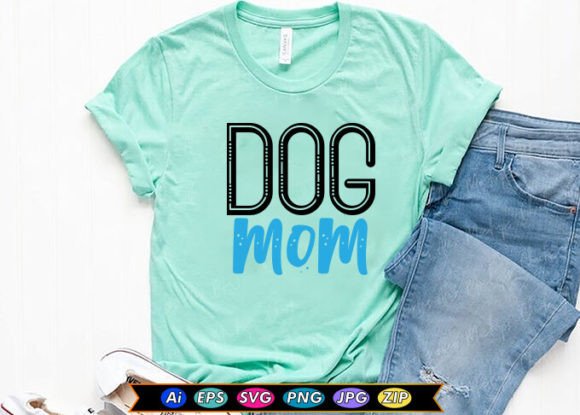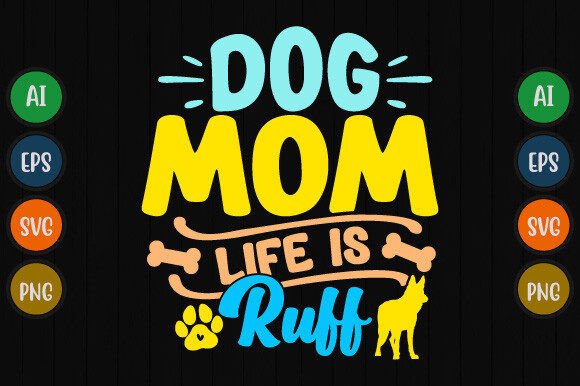
Dog Mom Life is Ruff T Shirt Design
First Impressions: Retro Charm, Clear Intent
Opening the Dog Mom Life is Ruff T Shirt Design, I immediately felt its warmth—not in color (it’s a clean vector, after all), but in voice. The calligraphy typography leans into playful retro greeting energy: slightly uneven baseline, gentle swashes on the “g” and “f”, soft weight transitions. It doesn’t shout “dog mom”—it winks. That matters. For embroidery designers and small shop owners, tone is half the sell. This isn’t a loud slogan; it’s a quiet nod between people who’ve cleaned up puppy accidents at 3 a.m. and still bought the matching bandana.
A Real Project Test: Embroidering a Linen Tote for a Local Pet Boutique
Last week, I prepped this design for a custom linen tote bag—part of a Mother’s Day capsule for a neighborhood pet boutique. Not a t-shirt, not a onesie—but a sturdy, textured canvas where clarity and stitch integrity are non-negotiable. I loaded the SVG file into my digitizing software, traced the outlines, and ran a test stitch on scrap linen with medium tear-away stabilizer. Here’s what stood out:
- The letterforms hold up beautifully under satin stitch—especially the curved “o” and “g”. No pinching or distortion, even at 3.5" wide.
- No fine interior details to lose: no tiny dots, no overlapping script strokes that’d vanish under fill stitch. That’s smart design restraint—and a huge win for embroidery reliability.
- Retro doesn’t mean cluttered. The spacing between “Life” and “is” gives breathing room for thread flow, reducing stitch density buildup in tight zones.
Where It Shines (and Where It Needs Care)
This Dog Mom Life is Ruff T Shirt Design excels in projects where personality meets practicality: embroidered sweatshirt cuffs, baby onesie chest placements, kitchen towel hems, and small-batch aprons. Its moderate height-to-width ratio makes it versatile across hoop sizes—comfortable in a 4"x4", still legible at 5"x7". As a machine embroidery design, it translates cleanly to applique design workflows too: you could easily cut the outline and use it as a layered fabric shape.
But be thoughtful with application surfaces:
- Avoid ultra-thin fabrics like lightweight rayon or single-layer gauze—without proper stabilizer, the satin stitch can ripple or pull.
- Caps and curved seams require extra hooping care. The slight curve of the baseline helps, but test on a cap blank first—especially if stitching near the bill seam.
- Dark fabric? Absolutely works—but confirm your thread colors pop. A warm charcoal grey thread on black cotton gives depth; neon yellow on navy reads instantly.
- Don’t force it onto tiny items like baby socks or keychain patches—the lettering loses charm when shrunk below 2".
What It Adds to Your Finished Product
As a handmade product, this design elevates perceived value without demanding premium time. Customers recognize “Dog Mom” as identity, not just text—and “Ruff” adds wit without sarcasm. That balance builds trust. On an Etsy listing for personalized gifts, it performs well in both photo mockups and real-life shots because it reads clearly from three feet away. No squinting. No decoding.
For craft business owners, it supports brand consistency: pair it with a simple paw-print icon or neutral palette, and you’ve got a cohesive line—tote bags, tea towels, pillow covers—all speaking the same warm, grounded language. It also lands well as a personalized gift: add a name in small script beneath (digitally or by hand), and it becomes quietly special—not mass-produced, but meaningfully tailored.
Practical Notes Every Embroidery Designer Should Check
Before cutting fabric or uploading to your machine:
- Test on scrap fabric—especially if using textured weaves like duck cloth or slubbed linen.
- Review stitch density in your digitized version. The original vector has no stitch data, so your digitizer must adjust for fabric type. Overly dense fills on this script will flatten its retro softness.
- Confirm hoop size compatibility with your intended garment. A 3.8" version fits neatly on a toddler sweatshirt chest; go wider only if your base fabric is stable and thick.
- Inspect small corners—like the tail of the “y” or the inner curve of the “D”. These areas need smooth vector paths to avoid jump stitches or thread breaks.
- Mock it up in black and white first. Does the contrast hold? If you’re planning a monochrome run (e.g., cream thread on oatmeal canvas), verify legibility before committing.
- Use appropriate stabilizer: medium cut-away for knits, tear-away for stable wovens, and bumpy iron-on for towels.
- Verify licensing before selling finished items or reselling the digital embroidery file. The product listing mentions vector formats (AI, EPS, SVG)—but commercial use rights aren’t stated. Always check.
Final Thought: A Reliable, Human-Centered Asset
This Dog Mom Life is Ruff T Shirt Design isn’t flashy—but it doesn’t need to be. In a sea of overdesigned, overcomplicated graphics, it’s refreshingly focused. It works for holiday embroidery, boutique branding, and Etsy seller inventory alike—not because it’s trendy, but because it feels true. When your customer unzips that embroidered tote or wraps that baby blanket, they’re not seeing a font. They’re feeling seen.
That’s the quiet power of good design assets. And that’s why this one earns space in my working library—not as filler, but as a go-to for heartfelt, stitch-ready storytelling.