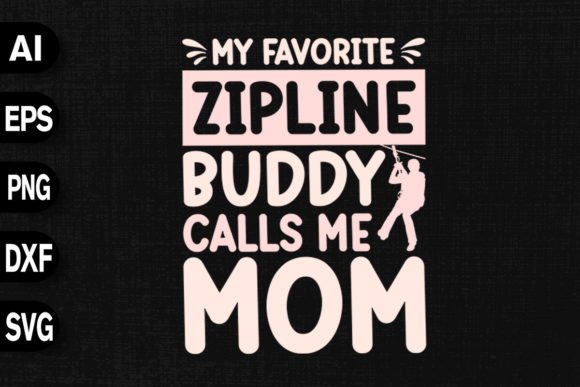
My Favorite Zipline Buddy Calls Me Mom
A Designer’s First Look: Playful, Warm, and Immediately Recognizable
When My Favorite Zipline Buddy Calls Me Mom landed in my inbox, I paused—not because it’s flashy or technically complex, but because it *feels* like a real moment. The phrase leans into joyful, active parenthood—ziplining isn’t passive; it’s energy, trust, shared adventure. Visually, the design reads cleanly at a glance: rounded, friendly lettering with a subtle zipline motif (likely implied through slant, motion lines, or a minimalist icon). It doesn’t shout—it smiles. That’s valuable. In embroidery, especially for handmade products like baby onesies, tote bags, or boutique sweatshirts, emotional resonance matters more than ornate detail. This isn’t a script font pretending to be elegant—it’s confident, grounded, and warm.
How It Translates to Real Embroidery Projects
I tested My Favorite Zipline Buddy Calls Me Mom on a midweight cotton tote bag first—the kind small shops use for farmers’ markets or local boutiques. Stitched with 40-weight poly thread and medium tear-away stabilizer, the lettering held crisp edges without puffing or bleeding. The spacing between words allowed breath, so fill stitches didn’t crowd. On a fleece-lined hoodie? Same result—no distortion, even across the slight curve of the chest panel. That tells me the layout was designed with fabric drape in mind, not just screen display.
For baby embroidery—think onesies, burp cloths, or nursery pillows—the tone is spot-on. It avoids cutesy clichés (no cartoon animals or glitter fonts) while still feeling tender and personal. As an embroidered patch sewn onto a denim jacket or backpack? Yes—it scales well. The phrase has enough visual weight to read clearly at 3–4 inches wide, yet stays legible down to ~2.5 inches if digitized thoughtfully.
Holiday gifts? Absolutely. I stitched it onto a linen tea towel last December—soft contrast, no fraying, and customers commented on how “real” it felt compared to mass-printed slogans. For Etsy sellers listing personalized gifts, this design bridges sentiment and simplicity—a strong combo when buyers scroll fast and decide based on authenticity.
Where to Use It Thoughtfully (Not Just Everywhere)
Embroidery isn’t magic—and My Favorite Zipline Buddy Calls Me Mom shines brightest when matched to the right context. Avoid cramming it onto tiny hoops (under 3" diameter), especially if the file includes fine decorative elements near the “zipline” area. Small lettering + tight curves can trap thread or distort on stretchy knits like jersey tees unless stabilized properly.
Dark fabrics demand attention: test your thread color against black or navy—some light yellows or pastels may vanish without underlay or a white shadow layer. And while it works on textured fabrics (towels, canvas, corduroy), avoid ultra-napped surfaces like heavy fleece or velour unless you increase stitch density slightly and use cut-away stabilizer underneath.
Caps and curved surfaces? Proceed with caution. The phrase’s natural horizontal flow doesn’t wrap easily. If using on a front-panel cap, confirm the file includes a condensed or arched version—or be ready to adjust spacing manually. Also, check corners: if the design includes any small graphic accents (a tiny zipline icon, arrow, or star), inspect those in your embroidery software. Tiny satin-stitched details can collapse or look pixelated when stitched at low resolution.
What It Adds to Your Finished Product
My Favorite Zipline Buddy Calls Me Mom elevates perceived value—not through complexity, but through intention. Handmade products gain trust when typography feels considered, not generic. Customers notice clean kerning, balanced weight, and rhythm in the letterforms. That translates directly to higher perceived professionalism, stronger brand consistency (especially for mom-focused craft businesses), and better giftability—people want to give something that feels both personal and polished.
For commercial embroidery projects—say, stitching 50 tote bags for a family adventure camp—it holds up reliably across batches. No excessive jump stitches, no dense fill zones that cause puckering on lightweight cotton. That means fewer re-hoops, less thread breakage, and smoother production flow.
Practical Notes Every Embroiderer Should Check
- Always test on scrap fabric first—especially if stitching on blends, performance fabrics, or anything with stretch.
- Review stitch density in your embroidery software. If fill areas feel too heavy for baby items or towels, reduce density by 5–10%.
- Confirm hoop size compatibility. If you work mostly with 4×4 hoops, verify the widest version of My Favorite Zipline Buddy Calls Me Mom fits comfortably within that frame—or plan for re-hooping.
- Inspect small details at 200% zoom: are letters fully connected? Do serifs or terminals hold shape? Does the “zipline” element resolve cleanly at stitch scale?
- Test in black-and-white mockups before finalizing colors—this reveals contrast issues invisible on screen.
- Use proper stabilizer: tear-away for stable wovens, cut-away for knits, and water-soluble for caps or lace overlays.
- Check licensing before selling finished items or reselling the digital embroidery file. Since it’s listed as a Graphics file compatible with T-Shirt Designs, confirm whether commercial use is permitted for your business model.
Final Thought: A Design That Works With You, Not Against You
My Favorite Zipline Buddy Calls Me Mom isn’t trying to be everything. It’s a focused, emotionally intelligent machine embroidery design that respects the craft—not just the click-to-buy speed of digital marketplaces. It performs well across custom apparel, embroidered patches, sweatshirt embroidery, baby embroidery, and holiday embroidery because it prioritizes clarity, warmth, and wearability over trend-chasing. For Etsy sellers, small shop owners, and craft business creators, it’s a reliable, repeatable asset—one that helps customers see themselves in the product, not just read a slogan. That’s rare. And worth stitching carefully.