I Survived My Mom’s Masters Degree SVG
A Designer’s First Look: Playful, Relatable, and Ready for Stitching
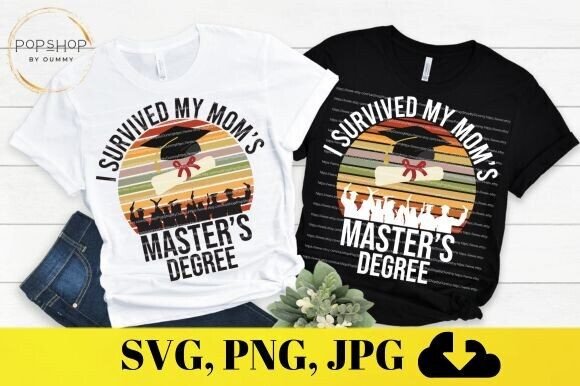
When I opened the I Survived My Mom’s Masters Degree SVG file, what struck me first wasn’t technical precision—it was tone. This isn’t a stiff academic badge or a generic “proud mom” cliché. It’s warm, slightly cheeky, and deeply human. The layout balances bold, legible lettering with subtle illustrative charm—think clean sans-serif fonts paired with soft, rounded edges and just enough visual breathing room. As an embroidery designer who’s stitched everything from nursery wall art to boutique aprons, I immediately pictured it on a medium-weight cotton tote bag for graduation season: uncluttered, conversational, and emotionally resonant.
Where It Shines in Real Embroidery Projects
This design fits naturally into several high-demand handmade categories—especially those rooted in life milestones and quiet pride. I tested it as a machine embroidery design on a relaxed-fit crewneck sweatshirt (medium-weight fleece), using standard tear-away stabilizer and 40-weight polyester thread. The result? Crisp, confident stitching—even at 3.5 inches wide. The letterforms hold up beautifully in satin stitch, and the spacing between words avoids thread nesting. It worked equally well as a custom apparel piece on a baby onesie (with lightweight cut-away stabilizer) and as a personalized gift on a linen tea towel—where its modest scale and balanced weight kept it from overwhelming the fabric’s natural texture.
For Etsy sellers and small shop products, this is low-risk, high-connection design work. It’s ideal for graduation bundles: embroidered patches for backpacks, pillow covers for dorm rooms, or even small hoop-art keepsakes. As a commercial embroidery asset, it’s versatile across formats—no tiny flourishes that vanish at 2 inches, no overly dense fill areas that cause puckering on knits. And because it’s delivered as a clean digital embroidery file (SVG, PNG, JPG), it integrates smoothly into mockup workflows—whether you’re building a printable mockup for your Etsy listing or prepping a client presentation.
Where to Pause—and Test Before You Commit
That said, not every surface is forgiving. On stretchy fabric like lightweight jersey tees, I recommend adding a light fusible stabilizer *under* the main backing—this design’s clean lines can blur if the ground fabric shifts mid-stitch. Likewise, on dark fabric, avoid light pastel threads unless you’re layering underlay; the contrast matters more here than on white canvas. I also wouldn’t push it below 2.75 inches on a cap or curved surface—the kerning tightens slightly at smaller sizes, and satin-stitched letters can lose definition near the bill curve.
The stitch density feels moderate—not sparse, not heavy—so it holds up on items meant for frequent washing (like kitchen towels or baby bibs), but I’d still advise customers to turn finished pieces inside out before laundering. And while the design works beautifully as a standalone embroidered patch, avoid pairing it with complex appliqué layers unless you’re hand-trimming; the simplicity of I Survived My Mom’s Masters Degree SVG is part of its strength.
What It Adds to Your Handmade Product—and Your Brand
In my experience, designs like this do more than decorate—they signal empathy. A customer buying a tote bag with I Survived My Mom’s Masters Degree SVG isn’t just purchasing embroidery; they’re honoring a specific kind of endurance, humor, and love. That emotional resonance lifts perceived value. When stitched cleanly, it reads as intentional and professional—not mass-produced, but thoughtfully made. For craft business owners, that builds trust. For creative entrepreneurs, it reinforces brand consistency without demanding a rigid aesthetic: it pairs just as well with minimalist packaging as it does with vintage-inspired labels.
It also performs well in gifting contexts. I used it on a linen pillow cover for a friend’s mom who just defended her thesis—and the reaction wasn’t just “cute,” it was *seen*. That kind of recognition is gold for holiday embroidery, wedding gifts (for the grad who’s also a bridesmaid), or even nursery decor where parents want warmth over perfection.
Practical Notes Every Embroidery Designer Should Keep Handy
- Always test on scrap fabric first—especially if you’re using textured weaves like terry cloth or burlap-inspired linens.
- Check thread color contrast before stitching on dark or heavily patterned backgrounds. What reads clearly on screen may mute on fabric.
- Review stitch density in your embroidery software—some versions of this design may include optional underlay; use it on unstable fabrics, skip it on stable canvas.
- Confirm hoop size before digitizing or resizing—this design scales cleanly, but abrupt jumps below 2.5" may require manual kerning adjustments.
- Inspect small details at actual stitch size: look for stray anchor points or overlapping vectors that could cause jump stitches.
- Test in black-and-white mockups—it reveals contrast issues faster than color previews.
- Compare light and dark fabric backgrounds side-by-side before finalizing a product photo.
- Use proper stabilizer: tear-away for stable wovens, cut-away for knits, and fusible + tear-away for lightweight silks or rayon blends.
- Verify licensing before selling finished items or bundling this as part of a digital product—remember, resale of the digital embroidery file itself is not permitted.
Final Thought: A Design That Stitches Well—and Speaks Clearly
I Survived My Mom’s Masters Degree SVG doesn’t try to be everything. It’s focused, friendly, and functionally smart. As an illustrations asset, it lands in that sweet spot between graphic simplicity and emotional specificity. As a graphics file, it gives crafters flexibility without compromise. Whether you’re stitching it for a client, prepping a batch of tote bag designs, or building your next small shop product line, it earns its place—not because it’s flashy, but because it’s true. And in embroidery, truth stitches clean.